The same information gets entered twice.
An enquiry arrives by email. Someone copies it into another tool. Then someone else copies part of it again.
Systems for real businesses
Enquiries come in. Emails pile up. Documents move around. Someone has to follow up. Someone else copies the same information into another system.
We connect that work, remove the repetitive parts and build systems that help your team keep things moving.
How work moves through a business, in five steps.
Work arrives, moves through the business and is recorded. A person still makes the decision.
Sound familiar?
An enquiry arrives by email. Someone copies it into another tool. Then someone else copies part of it again.
A quote needs checking. A document needs filing. A customer needs a reply. Nothing is difficult, but somebody has to remember every step.
The inbox has the conversation. The spreadsheet has the numbers. The CRM has the customer. Nobody has the whole picture.
This is the kind of mess we fix.
What we do
Sometimes you need automation.
Sometimes you need a small application built around the way your team works.
Sometimes your website needs to do more than show information.
And sometimes the tools you already pay for simply need to work together properly.
We start with the problem.
Then we build what makes sense.
Workflow automation
Connect repetitive steps so information gets captured, routed, prepared and recorded without somebody pushing it along all day.
Custom application development
We build focused applications, portals and internal systems around the way your business actually works.
Web development
We build websites that can capture enquiries, start processes and connect customers to what needs to happen next.
Content and social operations
We build a simple system for turning ideas and business knowledge into content that can be prepared, reviewed and published consistently.
Product and commerce operations
We help businesses organise product information and move approved changes to the places that need them.
In practice
Usually, it starts with a piece of work that somebody is doing by hand over and over again.
Instead of copying details between an inbox, a spreadsheet and another system, the information moves where it needs to go, and a person steps in where judgement is required.
The document does not just disappear into a folder. The useful information becomes part of the work that follows.
Follow-up no longer depends on somebody remembering to check a list at the end of the day.
The exact flow is different in every business. The principle is not.
Real work
We run our own quotations and invoices on a system we built. Here is one quotation, from an ordinary email to a saved draft.
Shown in a controlled test environment with an invented customer.
See it step by step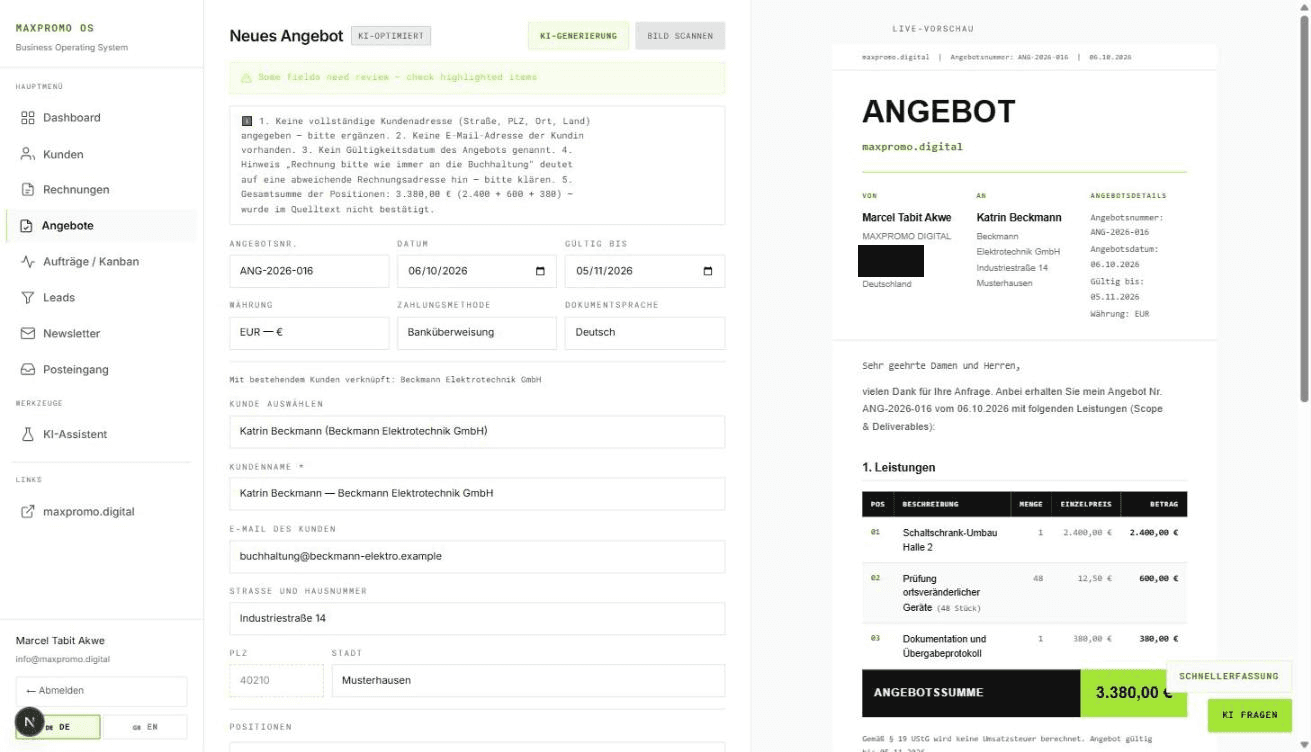
The tools aren’t the point
You don’t need to replace everything. Often the biggest improvement comes from getting the systems you already have to stop behaving like separate islands.
Technology names are shown only to explain the systems we can work with. They do not imply a partnership or endorsement.

Why Maxpromo
I started working with websites, content management systems, databases, hosting and business software more than 15 years ago.
Back then the tools were different, but the problems were surprisingly familiar.
Maxpromo grew out of that experience.
Today the work includes automation, AI and agents, and things that were much harder to build a few years ago. But my rule hasn’t changed:
Understand the work first. Then choose the technology.
Marcel AkweFounder, Maxpromo Digital
Read our storyNot ready to talk?
Six questions. No sales score. Just a clearer view of where work may be getting stuck.
Useful, not noisy