Joomla Rescue
Still Running Joomla in 2026? Here's What It's Actually Costing You
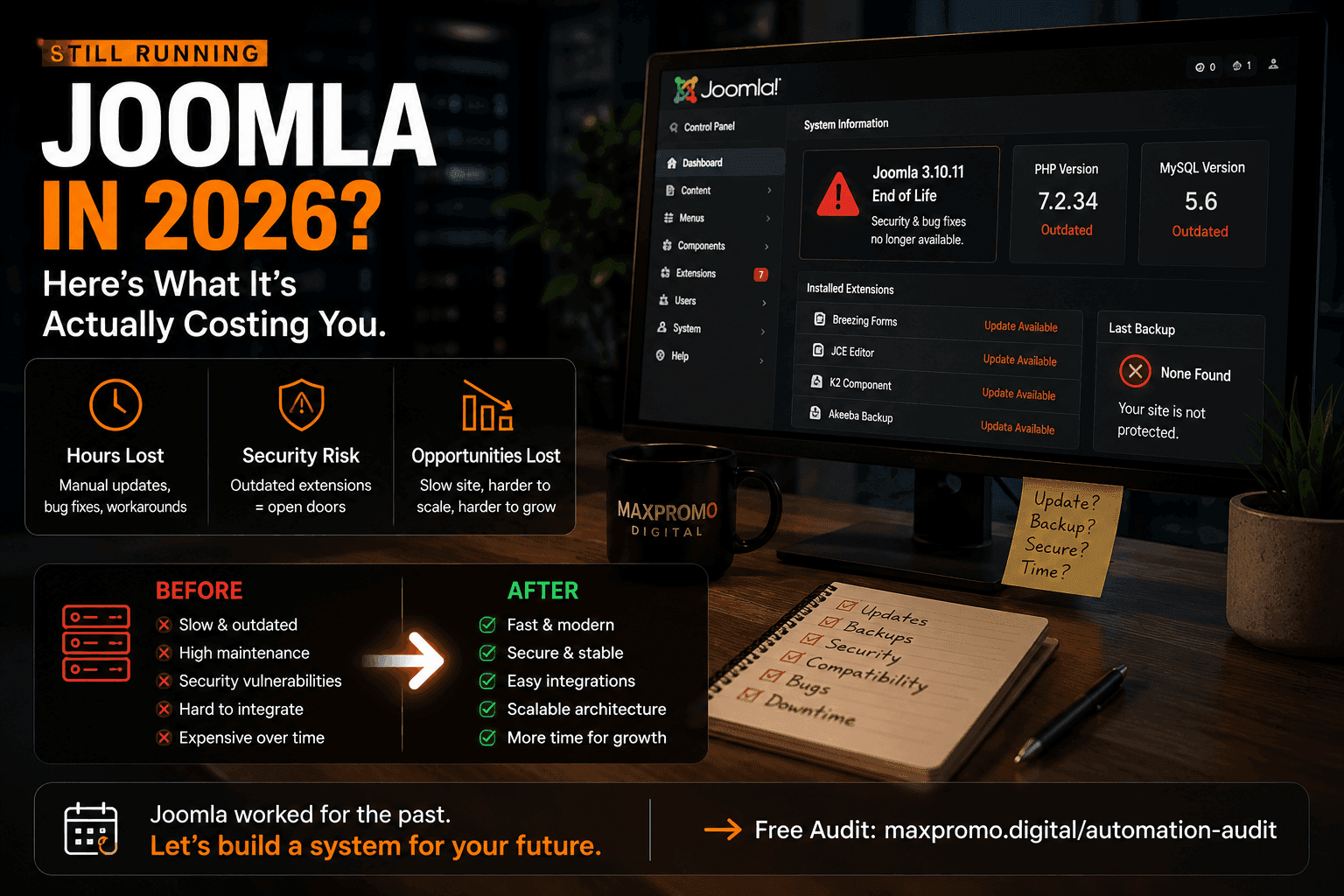
Joomla isn't broken. But it's costing you time, money, and opportunities every month. Here's what's really going on under the hood.
The Pattern We Keep Seeing
A business owner reaches out. Their site has been running on Joomla 3 since 2014. The developer who built it hasn't responded in two years. A plugin broke after the last update, and now the contact page doesn't work.
This isn't unusual. It's the most common scenario we encounter when businesses come to us: a website that's technically still online but operationally dead.
We've been working with Joomla since 2009 — starting with Joomla 1.5 on shared hosting environments, then through the 2.5 era, and eventually into Joomla 3 which is where most of our clients are stuck today. We know the platform's strengths. We know its limits. And we know precisely where it stops working for the businesses running it.
What Joomla Is Actually Costing You in 2026
Most business owners run the numbers like this: "I pay my hosting plan, the site is up, so it's not really costing me anything extra." That works on a bank statement. Not in reality.
What Joomla is really costing you:
-
Developer time for every update. Joomla updates aren't one-click. When you need to hire someone for each update, you're spending £50–£200 on something your competitors handle automatically.
-
Plugin chaos. Most Joomla installs we see have 15–40 extensions installed. Many are unmaintained. Some have active security vulnerabilities with no patch available.
-
Hosting-triggered crashes. We've repeatedly seen hosting providers — GoDaddy, Hostinger, A2 Hosting — automatically upgrade their server's PHP version, which breaks Joomla 3 installations without warning. Nobody notices until a customer calls.
-
Broken mobile experience. Joomla templates from 2013–2016 aren't properly responsive. More than 60% of your visitors are on mobile.
-
Load times. Old PHP versions, no modern image formats, no server-side rendering optimizations. Google's Core Web Vitals make the cost visible.
-
No editorial independence. You can't update content yourself without either technical knowledge or a developer invoice.
Why Businesses Don't Touch It
The answer is almost always the same: "We're worried about what we'd lose."
That's a legitimate concern. Joomla systems accumulate over years: SEO rankings, thousands of content pages, forms integrated with third-party systems, client data and media libraries.
A migration that ignores these realities would cause real damage. We know that. Which is why we approach it differently.
What a Clean Migration Looks Like
We've run Joomla migrations — including a website originally built around 2014 that we successfully moved into a modern CI/CD deployment workflow — that systematically address these risks:
URL mapping: Every existing URL gets a defined destination in the new structure. Where URLs change, 301 redirects are configured. Google sees no disruption.
Content audit: We look at what's actually getting traffic — and what's had zero visits since 2018. What works comes across. What doesn't, doesn't.
Parallel operation: No big-bang launch. The new site runs alongside the old one on a staging domain. Only when everything checks out do we switch DNS.
Modern CMS underneath: Not a new Joomla installation. Not WordPress. A headless CMS you can actually operate yourself.
What Changes After
A business we worked with in mid-2025: Joomla 3, 12 years old, five developers over the years, hosted on Hostinger with an outdated PHP version, two extensions without an update since 2020.
After migration:
- Page load time: from 6.2 seconds to under 1 second
- Google rankings: top positions for key terms remained intact
- Editorial effort: from "call the developer" to "done in 5 minutes"
- Hosting cost: from £89/month to £19/month
Those are documented outcomes from a real project.
When Is the Right Time to Migrate?
There's no perfect moment. But there are clear signals: last Joomla update more than 6 months ago, no reliable developer contact, site doesn't work properly on mobile, can't make content changes yourself, hosting provider upgraded PHP and something started behaving strangely.
If three or more apply: the best time to act was a year ago. The second best is now.
Contact
Still running an old website?
Show us your current website, CMS, workflow, online shop or manual process. We identify what can be modernized, automated or transformed.
Continue reading: How to Migrate Away From Joomla Without Losing Your SEO Rankings →
Ready to install a system?
Still running an old system?
Tell us what you need help with. No commitment.
Related services